

From APEC Shenzhen to Global Markets: MBH Fitness IT R&D Office Powering China Smart Fitness Global Rise
When the 2026 APEC CEO Summit opened its doors in Shenzhen’s Qianhai Free Trade Zone, it did not merely assemble global business leaders to discuss macroeconomic cooperation. It also cast a spotlight on a quiet, transformative shift unfolding across the city’s industrial landscape: the rise of specialized, tech-driven manufacturing enterprises that are no longer competing on low costs, but redefining the global rules of their industries through deep, user-centric innovation. Among these enterprises, MBH Fitness, a long-standing leader in China’s smart fitness equipment sector, smart fit gym equipment, has positioned its Shenzhen IT Research and Development Office at the very heart of this new story.
The timing of the 2026 APEC CEO Summit in Shenzhen has given MBH’s local IT R&D layout even deeper strategic significance. As one of the 11 provincial-level "little giant" specialized and innovative enterprises from Ningjin, MBH’s independent innovation path perfectly echoes the summit’s call for deeper regional industrial cooperation. At this year’s summit, representatives from 115 Fortune Global 500 companies and participants from 21 APEC economies and 13 non-regional economies gathered in Shenzhen, bringing unprecedented opportunities for outstanding local tech-enabled manufacturing enterprises to connect with global markets. The Shenzhen IT R&D center, located at the intersection of global supply chain resources and digital talent gathering, has already become MBH’s key platform to participate in this wave of regional cooperation: the AI fitness solutions developed here are being localized for users in Southeast Asia, Oceania and other APEC economies, and the intelligent system that connects equipment, app and AI coach is gradually being recognized by global partners.
For decades, the global fitness industry followed a predictable path. Manufacturers focused on building sturdier frames, quieter motors and more durable belts for treadmills and ellipticals. App developers created standalone workout tools. Personal trainers delivered one-size-fits-all guidance that could never be scaled to millions of users. The entire ecosystem was fragmented: equipment recorded data that never reached the coaching app, the app generated plans that had no connection to the actual performance of the hardware, and users were left jumping between three separate systems with no seamless flow. This broken loop wasted potential, frustrated millions of fitness seekers, and left a massive gap between the promise of smart fitness and the reality of most people’s daily workouts.
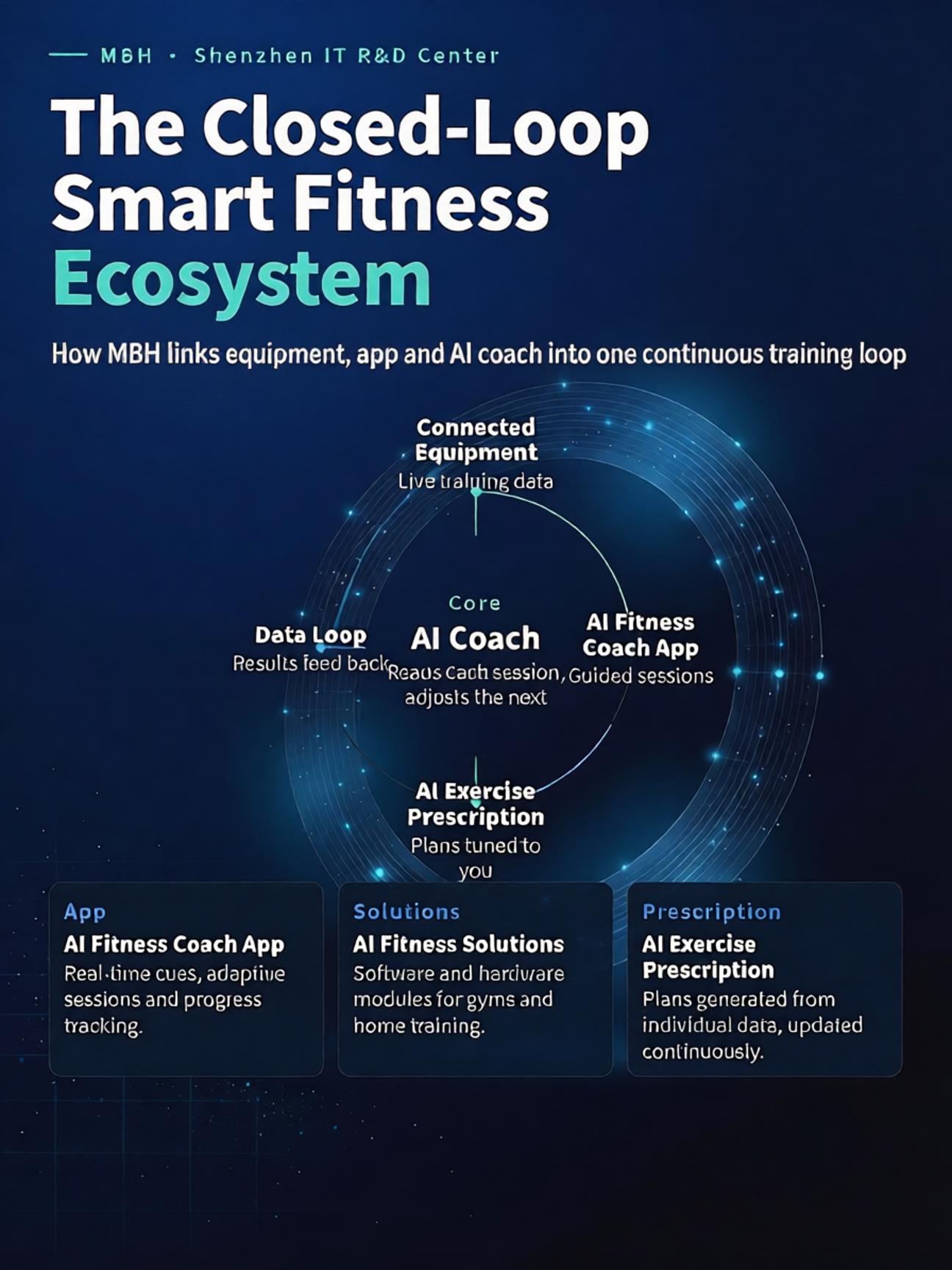
This is the exact gap that MBH’s Shenzhen IT R&D office was built to close. Unlike traditional corporate branches that serve only as a sales outpost or a temporary testing lab, this office was conceived from the start as the brand’s global technology brain for intelligent fitness. Its mission is not to make incremental improvements to existing products, but to rebuild the entire user experience around a single, unbroken ecosystem that links physical equipment, mobile applications and an adaptive AI coach into one unified system.
Their three core pillars of innovation — the AI fitness app, comprehensive AI-powered fitness solutions, and dynamic AI workout prescription system — are not separate projects, but interconnected nodes in a single closed-loop architecture. When a user steps onto an MBH smart treadmill at the gym, smart equipment can also support digital displays, connected applications, training data, and synchronized workout programs, depending on the model and configuration.
This is not the “smart fitness” the market has known for years — it is a truly responsive, connected system that learns, adapts and grows with the user.What makes this Shenzhen IT R&D office irreplaceable is its deep integration with the city’s one-of-a-kind innovation ecosystem. Shenzhen is not just a city with fast internet and convenient logistics. It is a place where you can walk from a semiconductor design lab to a precision sensor factory in 40 minutes, where top AI talent from across the country gathers to work on real-world industrial problems, and where every link in the digital manufacturing supply chain is within arm’s reach. This proximity allows the MBH team to test new AI motion capture models on a prototype rowing machine in the morning, adjust the app’s user experience based on that feedback in the afternoon, and run a real-world trial with local fitness enthusiasts that same evening. No other city in the Asia-Pacific region can deliver this kind of rapid, iterative innovation speed.
The 2026 APEC CEO Summit, held right in the heart of this ecosystem, has given MBH’s Shenzhen IT R&D mission a far broader, regional and even global significance. As leaders from 21 APEC economies gathered to discuss building a more inclusive digital economy, the work happening inside MBH’s Shenzhen office offered a concrete example of what that vision can look like. For millions of users across the Asia-Pacific, especially in regions where professional personal trainers are expensive or hard to access, MBH’s closed-loop AI fitness system can bring high-quality, personalized fitness guidance into every household. It turns a high-end fitness service that was once only available to a small wealthy group into an affordable, accessible daily experience for ordinary families.
This is the deeper importance of the Shenzhen IT R&D office. It is not just a tech center that helps one company sell more equipment. It is a bridge that connects the advanced manufacturing capabilities of China’s industrial heartland, the digital innovation resources of Shenzhen, and the vast, diverse consumer markets across the entire APEC region. As global trade patterns shift and the Asia-Pacific becomes the world’s fastest-growing market for smart health products, the work done here will set new industry standards. It will prove that Chinese manufacturing enterprises can move far beyond OEM production, and lead the world in creating entirely new categories of intelligent, user-centric products that improve people’s daily lives.
Long after the 2026 APEC CEO Summit closes its conference halls, the quiet innovation work in MBH’s Shenzhen IT R&D office will continue. Every new algorithm iteration, every optimized AI workout prescription, every small improvement to the seamless connection between equipment and app, is a step toward a future where smart fitness is no longer a gimmick, but a natural, supportive part of everyone’s daily health routine. In that future, the story of MBH’s Shenzhen IT hub will be remembered not just as a success story for one company, but as a landmark moment when the global fitness industry crossed over from the mechanical age into the intelligent and connected era.