


Commercial Gym Floor Plan
Your Commercial Gym Floor Plan: Equipment Layout That Actually Works
Walking into an empty space with a stack of equipment invoices and a tape measure is where most gym layouts go wrong. The difference between a profitable floor and a chaotic one comes down to three things: zone planning, equipment density, and member flow. Let's break down how to configure your space so every square foot earns its keep.
Start With Your Space Budget
Before picking a single machine, calculate your net usable floor area. Deduct 15-20% for walls, columns, restrooms, and reception. You're left with the floorplan that actually holds equipment.
General density guidelines for commercial gyms:
- Boutique studios (under 2,000 sq ft): 35-45 sq ft per member at peak
- Mid-size facilities (2,000-5,000 sq ft): 50-60 sq ft per member
- Large commercial gyms (5,000+ sq ft): 65-80 sq ft per member
- Selectorized strength zones: 50-65 sq ft per machine (includes access space)
- Free weight areas: 80-100 sq ft per station
- Cardio zones: 40-50 sq ft per machine
These numbers keep your floor functional during peak hours. Push density higher and you create bottlenecks. Go lower and you're wasting rent.
Zoning Your Gym Floor
Every successful commercial gym floor plan has six distinct zones. The order matters for safety and traffic flow.
Cardio Zone Placement
Put cardio near windows or front glass. Natural light helps members stay engaged during longer sessions. Keep treadmills and bikes at least 3 feet apart side-to-side, and 6 feet behind for DL800 Commercial Treadmill
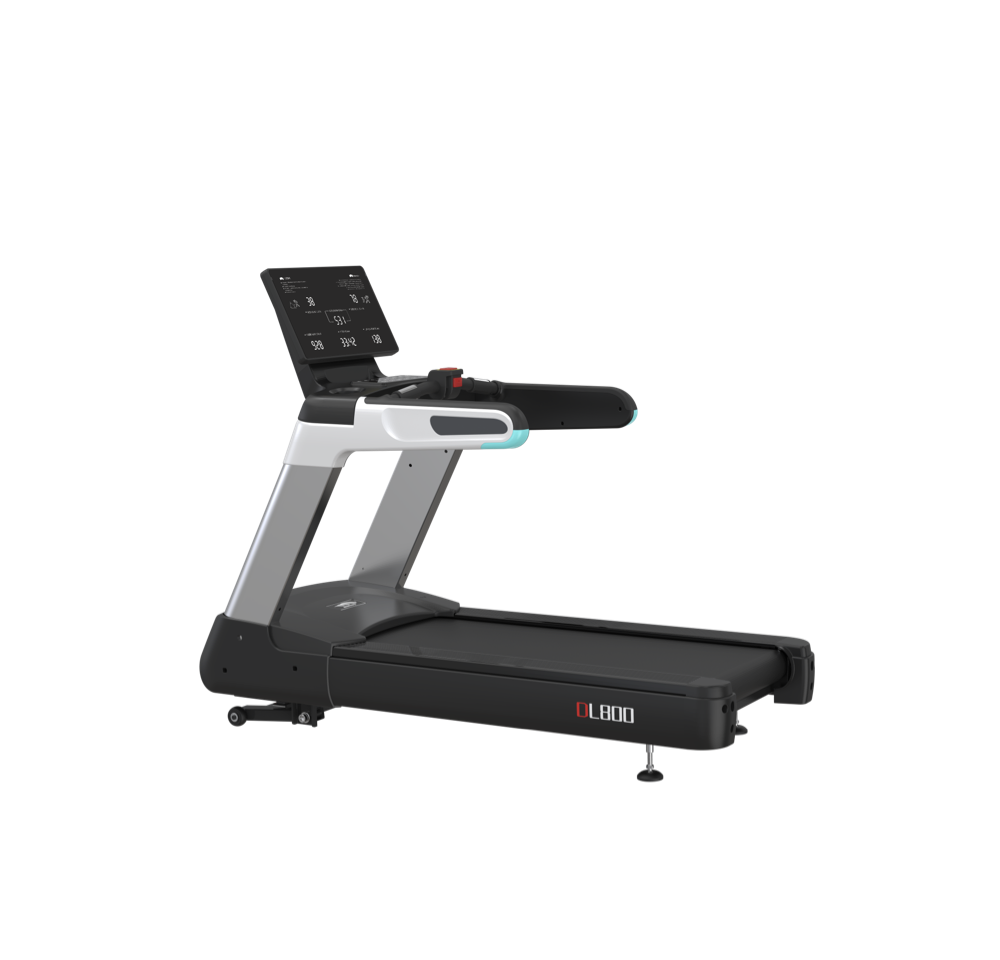

Orient cardio machines facing the same direction or in a staggered grid. Face-to-face layouts make members uncomfortable and increase perceived crowding.
Selectorized Strength Zone
This is your highest-revenue zone per square foot. Arrange machines in logical muscle group clusters. Place chest and shoulder presses together, back and row machines nearby, and leg equipment in its own row.
A typical 25-machine lineup using MEL-001 Chest Press
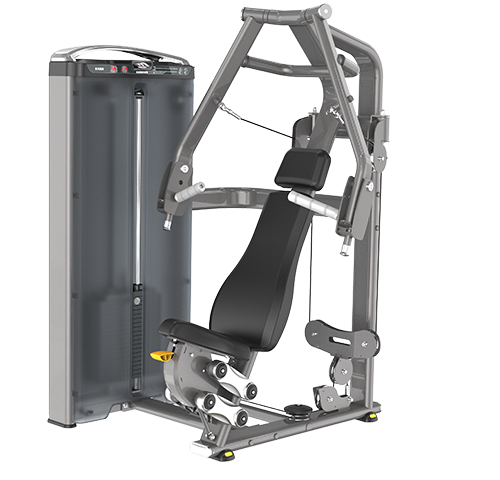
The MEL-014 Leg Extension and MEL-013A Horizontal Leg Curl pair naturally side by side. Members can superset without moving far. Put MEL-018 Adductor & Abductor at the end of the leg row since it has both adduction and abduction functions in one station.
Free Weight Zone Layout
Free weights need the most square footage per member and the strictest safety planning. Put this zone in a corner or along a back wall. Never place it near walkways or entrance points.
Dumbbell racks need 6-8 feet of clearance on the front side for pressing and curling. The XHA-030 Dumbbell Rack holds 10 pairs per side, so a double-sided rack needs 12 feet of linear wall space. Place adjustable benches nearby: XHA-037 Adjustable Bench and XHA-023A Weight Bench (Premium) should be within 3 steps of the dumbbell rack.
Barbell stations need dedicated floor space. Each XHA-039 Barbell Rack or ZH-020 Smith Machine requires an 8x8 foot footprint minimum. The ZH-020B Smith Machine has a similar footprint but the guide rods need 7 feet of ceiling clearance. Check your ceiling height before placing these.
Plate Loaded Zone
Plate loaded machines appeal to intermediate and advanced members. They take up more space than selectorized because you need room for weight storage and loading.
The MEL-001A Chest Press and MEL-012C Lat Pull Down are good anchor machines for this zone. The MEL-015 Leg Press needs extra clearance for loading plates. Budget 70-80 sq feet per plate loaded machine, compared to 50-60 for selectorized.
Place MEL-013 Horizontal Leg Curl and MEL-016 Standing Leg Extension near the leg press to create a leg training corner. Members appreciate having all leg options in one zone.
Cable and Functional Training Zone
Cable machines need the most headroom and floor space of any strength equipment. A XHA005 Cable Crossover needs a 12x8 foot minimum footprint plus 6-8 feet behind each side for cable pulls. The ZH-005 Cable Crossover has a slightly more compact frame but still needs that clearance.
Functional trainers like the ZH-005A Functional Trainer and ZH-005B Adjustable Functional Trainer can go on end walls or in corners. One functional trainer per 500 sq feet of floor space is a good rule for most commercial gyms.
Core and Stretching Zone
Don't skimp on this zone even though it's low-revenue per foot. Members need space for warmups, cooldowns, and ab work. Put this area near the free weights since members often combine them.
The XHA-027 Vertical Knee Raise, XHA-032 Abdominal Machine, and MEL-010 Abdominal Crunch can line a wall. The XHA-035 Crunch Bench and MEL-009 Lower Back pair well together for circuit training.
Equipment Density by Member Profile
Your target clientele dictates equipment mix more than floor size. Calculate based on peak-hour traffic, not total membership.
For General Commercial Gyms
Standard ratio: 40% cardio, 30% selectorized strength, 20% free weights, 10% functional and plate loaded. A 5,000 sq foot gym would carry roughly 25-30 cardio units, 15-20 selectorized machines, 8-10 free weight stations, and 4-6 functional stations.
Strength machines like the XMDM-001 Chest Press or MTMS-001 Chest Press should be duplicated in pairs. One chest press creates bottlenecks. Two side-by-side doubles throughput without doubling floor space.
For Strength-Focused Facilities
Flip the ratio: 20% cardio, 40% strength machines, 30% free weights, 10% specialty. These gyms need more plate loaded units and heavier dumbbells up to 150 lbs.
The XHA-022 Incline Squat Machine(45°) and XHA-031 Deadlift Machine are essentials for strength-focused member bases. Plan for 90-100 sq feet per heavy specialty machine.
For Boutique and Semi-Private Studios
Smaller spaces need versatile equipment. The PL-08 Multi-functional Smith Machine does the work of three machines in one footprint. Pair it with a ZH-005A Functional Trainer and a few dumbbell racks and you can coach 12-15 clients per session.
Boutique studios should aim for 30-35 sq feet per member at peak capacity. You'll run more circuit-style programming, so equipment spacing can be tighter at 40-45 sq feet per station.
Walkways and Emergency Clearance
Every gym floor plan must meet local fire codes. Minimum 44-inch main aisles, 36-inch secondary aisles. Primary exit paths need 6-7 feet clearance. Check your jurisdiction because commercial gym codes vary by city.
Place XHA-041 Weight Plate Tree and XHA-039 Barbell Rack away from main walkways. Members stop at these, and stopping zones should never block traffic lanes. Same for MEL-006 Biceps Curl and MEL-007 Triceps Press which are often supersetted together. Keep them in a dedicated arm training corner.
Power and Flooring Considerations
Cardio machines need dedicated circuits. Each M005-LED Commercial Treadmill or DL800 Commercial Treadmill draws 10-15 amps. Plan for 20-amp dedicated circuits per two treadmills. Bikes like the M-7808R Upright Bike draw less but still need proper power distribution.